
Cargando...
Nobel Women
Venue
Revillagigedo Palace
Gijón
Dates
from 01/17/2023—to 04/09/2023
The 'Nobel Women” exhibition, organised by Gijón City Council and Rocaviva, with the collaboration of Cajastur and the Asturian artist Marcos Tamargo, arrived at the Revillagigedo Palace, Gijón.
The official opening was attended by Marie Curie's grandchildren, the scientists Pierre Joliot and Hélène Langevin-Joliot, the mayoress of the city, the director of the Cajastur Foundation and the exhibition curators. It was an emotional event during which the packed audience paid tribute to the two great scientists who had come from Paris expressly for the occasion.
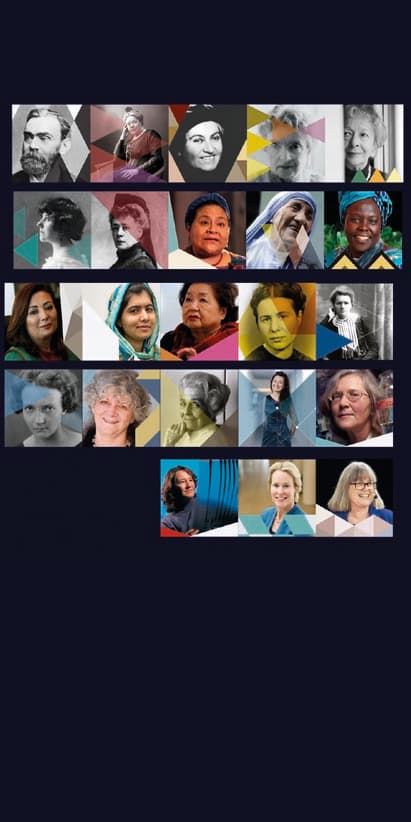
The beautiful Revillagigedo Palace, located on the seafront, was the ideal setting for the exhibition, with rooms featuring large balconies, and a central glazed courtyard. It was in that very courtyard that visitors encountered a huge 5-metre banner bearing the faces of the exhibition’s protagonists.
First floor
The first room was devoted to Alfred Nobel, and featured biographical panels, paintings, a scarf designed in his honour by Daphné, the Italian house of haute couture, and some of the crockery used at the annual Nobel Banquet.
The second room was devoted to the family with the most prizes in history, the Curie family, which has five Nobel Prizes: Pierre and Marie Curie, for Physics (1903), Marie Curie, who won the prize for her work in Chemistry in 1911, and Irène and Frédéric Joliot-Curie, who shared the prize for Chemistry in 1935. Among many other items on display in the room were original paintings by Eugenio López-Berrón, photographs, a lithograph of Picasso's portrait of Frédéric Joliot-Curie, international philately and numismatics, banknotes and a reconstruction of Marie Curie's laboratory.
The central patio on the first floor hosted the winners for Chemistry (Ada Yonath, 2009 and Frances Arnold, 2018); Physics (Donna Strickland, 2018) and Philosophy or Medicine (Rita Levi-Montalcini, 1986; Carol Greider and Elizabeth Blackburn, 2009 and May-Britt Moser, 2014). The high quality, attractive biographical panels were accompanied, as on other occasions, by original photographs, reproductions of Nobel Diplomas, books in various languages, handwritten letters, international stamps and the silhouettes of the prize winners, among many other pieces.
The third room was devoted to Nobel Women for Literature, represented by Gabriela Mistral (1945), Nelly Sachs (1966) and Wislawa Szymborska (1996). In this large room there were books by the authors, international stamps, an original piece by the artist Jaime Sicilia, the silhouettes of the prize-winners and, as the centrepiece, a reconstruction of Nelly Sachs' workspace, with a reproduction of the large watercolour entitled 'Bookshop' by the Swedish artist Lars Lerin.
The fourth room and inner corridor were devoted to the first woman to win the Nobel Prize for Literature, Selma Lagerlöf (1909), and featured a reconstruction of the house where she was born - thanks to the large watercolour of Marbacka on loan from the artist Lars Lerin - in addition to a copy of her Nobel Diploma, several editions of her famous work 'Nils Holgersson's Wonderful Journey through Sweden' and other titles by the writer in various languages. The room concluded with the Spaniard Concha Espina, the female author who has come closest to winning the coveted award. On show were photographs, newspaper articles, first editions of her books, a painting by her granddaughter - the great artist Concha de la Serna -, diplomas, her 'sentimental testament”, and other exhibits.
The first floor ended with a room devoted to audiovisuals on the award winners and the Asturian artist Marcos Tamargo.
Second floor
On the second floor a large room was devoted to winners of the Nobel Peace Prize: Bertha von Suttner (1906), Teresa de Calcuta (1979), Rigoberta Menchú (1992), Wangari Maathai (2004), Malala Yousafzai (2014), Ouided Bouchamaoui (2015) and Setsuko Thurlow (2017). Unique pieces were on display in the room, including an original sculpture of Mother Teresa of Calcutta, silver coins depicting various humanitarian organisations, books in various languages, letters from the award winners, personal objects, international philately, and the reconstruction of Wangari Maathai's birthplace, with a mannequin wearing a traditional Kenyan costume and a reproduction of a watercolour of Mount Kenya, the work of Concha de la Serna.
The courtyard on this floor was devoted to large black and white photographs and silhouettes of the prize-winners.
The final room was devoted to the work of the Asturian artist Marcos Tamargo, who has worked with Rocaviva Events for years on the production of original work related to the female prize-winners. In this area, several paintings were on view which used his MoveArt technique, whereby the same canvas contains two works: one that can be seen in natural light and another that can only be seen in the dark. The work on show on this occasion were Alfred Nobel, Marie Curie, Selma Lagerlöf, Nelly Sachs, Setsuko Thurlow, Wangari Maathai and May-Britt Moser.
Finally, by way of a farewell from the exhibition, a large panel shows all the female prize-winners in all the specialities established by Alfred Nobel, who total only 59 out of a total of more than 900 prize-winners since the prize was launched in 1901.
The exhibition was a great success with the public; so much so that the exhibition, initially scheduled to run until 11 March, was extended until 9 April.
The 'Nobel Women” exhibition, organised by Gijón City Council and Rocaviva, with the collaboration of Cajastur and the Asturian artist Marcos Tamargo, arrived at the Revillagigedo Palace, Gijón.
The official opening was attended by Marie Curie's grandchildren, the scientists Pierre Joliot and Hélène Langevin-Joliot, the mayoress of the city, the director of the Cajastur Foundation and the exhibition curators. It was an emotional event during which the packed audience paid tribute to the two great scientists who had come from Paris expressly for the occasion.
The beautiful Revillagigedo Palace, located on the seafront, was the ideal setting for the exhibition, with rooms featuring large balconies, and a central glazed courtyard. It was in that very courtyard that visitors encountered a huge 5-metre banner bearing the faces of the exhibition’s protagonists.
First floor
The first room was devoted to Alfred Nobel, and featured biographical panels, paintings, a scarf designed in his honour by Daphné, the Italian house of haute couture, and some of the crockery used at the annual Nobel Banquet.
The second room was devoted to the family with the most prizes in history, the Curie family, which has five Nobel Prizes: Pierre and Marie Curie, for Physics (1903), Marie Curie, who won the prize for her work in Chemistry in 1911, and Irène and Frédéric Joliot-Curie, who shared the prize for Chemistry in 1935. Among many other items on display in the room were original paintings by Eugenio López-Berrón, photographs, a lithograph of Picasso's portrait of Frédéric Joliot-Curie, international philately and numismatics, banknotes and a reconstruction of Marie Curie's laboratory.
The central patio on the first floor hosted the winners for Chemistry (Ada Yonath, 2009 and Frances Arnold, 2018); Physics (Donna Strickland, 2018) and Philosophy or Medicine (Rita Levi-Montalcini, 1986; Carol Greider and Elizabeth Blackburn, 2009 and May-Britt Moser, 2014). The high quality, attractive biographical panels were accompanied, as on other occasions, by original photographs, reproductions of Nobel Diplomas, books in various languages, handwritten letters, international stamps and the silhouettes of the prize winners, among many other pieces.
The third room was devoted to Nobel Women for Literature, represented by Gabriela Mistral (1945), Nelly Sachs (1966) and Wislawa Szymborska (1996). In this large room there were books by the authors, international stamps, an original piece by the artist Jaime Sicilia, the silhouettes of the prize-winners and, as the centrepiece, a reconstruction of Nelly Sachs' workspace, with a reproduction of the large watercolour entitled 'Bookshop' by the Swedish artist Lars Lerin.
The fourth room and inner corridor were devoted to the first woman to win the Nobel Prize for Literature, Selma Lagerlöf (1909), and featured a reconstruction of the house where she was born - thanks to the large watercolour of Marbacka on loan from the artist Lars Lerin - in addition to a copy of her Nobel Diploma, several editions of her famous work 'Nils Holgersson's Wonderful Journey through Sweden' and other titles by the writer in various languages. The room concluded with the Spaniard Concha Espina, the female author who has come closest to winning the coveted award. On show were photographs, newspaper articles, first editions of her books, a painting by her granddaughter - the great artist Concha de la Serna -, diplomas, her 'sentimental testament”, and other exhibits.
The first floor ended with a room devoted to audiovisuals on the award winners and the Asturian artist Marcos Tamargo.
Second floor
On the second floor a large room was devoted to winners of the Nobel Peace Prize: Bertha von Suttner (1906), Teresa de Calcuta (1979), Rigoberta Menchú (1992), Wangari Maathai (2004), Malala Yousafzai (2014), Ouided Bouchamaoui (2015) and Setsuko Thurlow (2017). Unique pieces were on display in the room, including an original sculpture of Mother Teresa of Calcutta, silver coins depicting various humanitarian organisations, books in various languages, letters from the award winners, personal objects, international philately, and the reconstruction of Wangari Maathai's birthplace, with a mannequin wearing a traditional Kenyan costume and a reproduction of a watercolour of Mount Kenya, the work of Concha de la Serna.
The courtyard on this floor was devoted to large black and white photographs and silhouettes of the prize-winners.
The final room was devoted to the work of the Asturian artist Marcos Tamargo, who has worked with Rocaviva Events for years on the production of original work related to the female prize-winners. In this area, several paintings were on view which used his MoveArt technique, whereby the same canvas contains two works: one that can be seen in natural light and another that can only be seen in the dark. The work on show on this occasion were Alfred Nobel, Marie Curie, Selma Lagerlöf, Nelly Sachs, Setsuko Thurlow, Wangari Maathai and May-Britt Moser.
Finally, by way of a farewell from the exhibition, a large panel shows all the female prize-winners in all the specialities established by Alfred Nobel, who total only 59 out of a total of more than 900 prize-winners since the prize was launched in 1901.
The exhibition was a great success with the public; so much so that the exhibition, initially scheduled to run until 11 March, was extended until 9 April.
